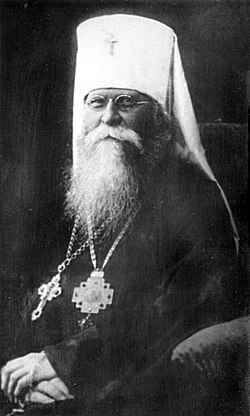
The Life of Metropolitan Damaskin (Balabanov), First Hierarch of the Russian Orthodox Church (1956–2021)
This blessed archpastor, in the world Viktor Mikhailovich Balabanov, came from the land of Belgorod, from peasant and churchly pious roots. He was born on January 11, 1956, in the Radkovsky district hospital, which in the days of the Orthodox tsars had once been called a zemstvo hospital. His native place was the hamlet of Novosyolovka on the bank of the Donetsk Seimitsa, among the villages of the Kursk-Belgorod black-earth country.
The Balabanov family came from the Galician-Volhynian principality, from the boyar Balaban, who had been among those close to the right-believing Prince Daniel of Galicia; and from this line there came not a few churchly men: archimandrites, bishops, and one metropolitan, Dionysius (Balaban), Metropolitan of Kiev and Galicia. The father of the future archpastor, Mikhail Afanasievich, the chief agronomist of a collective farm, was grievously wounded in the war near Korsun-Shevchenkovsky; an exploding shell tore off his right arm, and a fragment passed through his chest and neck without touching, by the wondrous protection of God, any vital vessel. His mother, Ekaterina Kirillovna, nee Shapovalova, labored in a field-work brigade; the care of the infant, however, fell to his paternal grandmother, Anastasia Gavrilovna, for his parents were burdened from morning until night with collective-farm labor.
It was impossible to baptize the newborn child in a patriarchal church: the Soviet authorities persecuted the baptism of infants among people in state service. Therefore, by the decision of his parents, on a winter night at the home of a catacomb elder who lived seven kilometers from the hamlet, Viktor received Holy Baptism, being fenced off from the Soviet false church. His first childhood memory was the touch of the warm hands of his great-grandmother Natalia, who in her youth had lived as a nun in a monastery destroyed by the Bolsheviks, and who to old age prayed secretly in her hut together with faithful people who came to her amid raging godlessness. By these signs it is understood that from infancy the Lord was preparing this child for future service.
His childhood and youth passed in peasant labors and in studies, first at school and then at the Kursk Agricultural Institute, where he met the man who later became his friend, spiritual father, and guide: Archpriest Valery Rozhnov. After graduating from the institute he came to the northern regions, to the Yudoma River, along the border of Khabarovsk Territory and the Ust-Maya District of Yakutia, and worked in the prospectors’ artel “Yurskaya,” mining gold in mountain ravines for twelve hours a day without days off. Among the frosts, mountains, and northern silence the beauty of God’s creation was opened to him, and contemplating the world as the work of the Creator, he turned his mind toward the Lord. For a long time Viktor sought the truth, examined Eastern teachings, read about Islam, but in each he found a dead end and dissatisfaction, and at last stopped at Orthodoxy as the fullness of truth. Returning to the Kursk land, he began to attend church and was received by Father Valery Rozhnov with love. Father Valery entrusted to him the reading of the Psalter for the departed. Viktor would travel to the dead at any hour of day or night, often far from home, through frost and ice, on foot and in passing vehicles, reading the Psalter over those for whom there was sometimes no one else to pray. He took no money for this labor and did not wish to accept even food, saying, “The reward is from the Lord, and I am unworthy.” In these labors he acquired prayerful collectedness and compassion for the sorrowing.
At the end of September 2003 Father Valery blessed him to go to the Kuban, to the newly consecrated Bishop Viktor (Pivovarov) of Slavyansk, who needed an assistant. Sitting on the bank of the village pond, Father Valery said to him, “You will be with Bishop Viktor as a novice; he will tonsure you into the mantle and ordain you a deacon; in three years, God willing, a presbyter. And I see you as a bishop of our Church.”
Arriving in Slavyansk-on-Kuban, Viktor settled at the church, carried out cell and parish obediences, helped Bishop Viktor with correspondence with the Paris secretary of the ROCOR(V) Synod of Bishops, Mitred Archpriest Benjamin Zhukov, read in church, served in the altar, and worked in the yard. He read the Holy Fathers without ceasing: Ephraim and Isaac the Syrians, John Climacus, John of Damascus, John Chrysostom, Basil the Great, Gregory the Theologian, Saint Demetrius of Rostov, and many others, learning from them the mind of the Church.
On December 11/24, 2003, the feast of Venerable Daniel the Stylite, Bishop Viktor tonsured him first as a rassophore and on the same day into the lesser schema, giving him the name Damaskin in honor of Hieromartyr Damaskin (Tsedrik), Bishop of Glukhov and Starodub, who suffered martyrdom in the years of Soviet warfare against God. Three days later, on December 15/28, the feast of Hieromartyr Eleutherius, Bishop of Illyria, and his mother, the Martyr Anthia, he was ordained reader and deacon. On the feast of the Circumcision of the Lord, January 1/14, 2004, the feast day of Saint Basil the Great, Archbishop of Caesarea in Cappadocia, he was ordained presbyter. Thus he was counted worthy of the hieromonkhood.
His priestly service began without a long apprenticeship, directly in parish labor: he baptized infants and adults, crowned marriages, served funerals, blessed homes, heard confessions, communed the sick, and traveled according to the needs of the flock. Through this service of needs he soon saw human sorrows not abstractly but in their sharpest need: illnesses, fears, family divisions, despair, and hope, and he learned compassion.
By blessing he was sent to distant lands: to South America, to Brazil and Uruguay, to the scattered Orthodox Russian people; he served Paschal and Lenten services, baptized, blessed homes, and also visited Chile; later he went to Canada, to the Holy Transfiguration Skete in Mansonville, where the residence of the First Hierarch of ROCOR(V), Metropolitan Vitaly (Ustinov), was located. Hieromonk Damaskin also served at the Voronezh parish, where the small community received him with love; he taught the Law of God in a technical school, cooperated with the Cossacks, and that parish became a spiritual and patriotic center.
On June 17, 2006, by decision of the ROCOR(V) Synod of Bishops, acting in the difficult circumstances of church administration, when Metropolitan Vitaly, Archbishop Anthony (Orlov), Bishop Vladimir (Tselishchev), and Bishop Bartholomew (Vorobiev) were formal members of the Synod, with the disputed position of Mitred Archpriest Benjamin Zhukov and the temporary participation of Bishop Viktor (Pivovarov), Hieromonk Damaskin was elevated to the rank of archimandrite and appointed secretary of the Synod of Bishops. Soon, according to the conciliar notice of Metropolitan Vitaly, he was summoned to the Holy Transfiguration Skete in Mansonville, for a decisive time had come: it was absolutely necessary to free the Church from unlawful administration through Mitred Archpriest Benjamin Zhukov and Lyudmila Dmitrievna Rosnyanskaya, and to gather the depleted episcopate.
On July 10/23, 2006, at the Extraordinary Council of Bishops in the Holy Transfiguration Skete in Mansonville, on the feast of Venerable Anthony of the Kiev Caves, the founder of all Russian monasticism, Archimandrite Damaskin was named and consecrated Bishop of Orel and Central Russia. The consecration was performed by Archbishop Anthony (Orlov) and Bishop Viktor (Pivovarov); at the same Council, Archimandrite Stefan (Babaev) was also consecrated Bishop of Ust-Sysolsk and Northern Russia. On that very day Damaskin received sorrowful news from his younger brother: his father, the servant of God Mikhail, had departed to the Lord, and just before his repose had repented and received the Holy Mysteries from the hands of Archpriest Valery Rozhnov, being received into the bosom of ROCOR(V). Thus the day of his episcopal consecration became a twofold day: of churchly height and filial sorrow, and the Lord foreshadowed in it that this episcopacy would be borne together with an unceasing cross.
From October 20/November 2 to October 25/November 7, 2006, an Extraordinary Council of Bishops was held in the cathedral church of the Central Russian Diocese in Shcherbinka. Bishop Damaskin took part in it both as the ruling bishop of the diocese and as secretary of the Synod of Bishops, and he was confirmed as a member of the Synod. This Council was the first held in Russia in the entire history of the Russian Church Abroad. At this same Moscow Council it was resolved to call the Church by its historical name: the Russian Orthodox Church. Thus the return of the center of church administration to Russia was joined to the return of the Church’s name.
In the episcopal rank he shepherded the Central Russian Diocese, establishing parishes, ordaining clergy, and instructing his children in the faith. But the enemy of the human race, who hates what is good, did not sleep, and soon grave accusations were raised against him. At the Council of Bishops in Slavyansk-on-Kuban, held from June 12/25 to June 15/28, 2007, accusations were brought against him. On July 16/29 of that same year, Bishop Damaskin received decree No. 11/07/M, signed by Metropolitan Anthony (Orlov), Archbishops Viktor (Pivovarov) and Stefan (Babaev), and Bishop Athanasy, forbidding him from priestly service for non-recognition of conciliar decisions. But Vladyka Damaskin, judging this prohibition to be uncanonical, rejected it, remaining faithful to churchly truth, and after the example of the ancient confessors endured slander, abandonment, and betrayal. He also suffered expulsion from the church in Shcherbinka: at night he was in effect driven out of the church house by the ktetor and his wife.
In those days of division and sorrow, when sanctions pressed upon him from every side and many departed from churchly truth, a wondrous vision was shown to the Vladyka in a dream. The Most Pure Virgin Theotokos appeared to him and gave him two clean sheets of paper, commanding him to write upon them. And it was made known to him that one of these sheets represented the Local Church on Russian soil, and the other the Russian Church Abroad, existing in the diaspora. Thus our Sovereign Lady comforted her servant in the hour of persecution and indicated beforehand that his word and care would be directed to both parts of the Russian Church: to that which is in the native land, and to that which is in dispersion.
From August 16/29 to August 19/September 1, 2007, an Extraordinary Council of Bishops of the Russian Orthodox Church gathered in the city of Zaporozhye. At this Council, after careful deliberation, two candidates for First Hierarch were considered: Bishop John (Zinoviev) and Bishop Damaskin (Balabanov). Vladyka Damaskin was elected First Hierarch of the Russian Orthodox Church and given the title Metropolitan of Moscow and All Russia. At the same Council, decisions were adopted for the ordering of full church life on the territory of Russia and Ukraine and for the strengthening of conciliar administration.
Placed at the head of the Church, Metropolitan Damaskin bore the cross of the first-hierarchical office with great diligence. He gathered the scattered flock of Christ, strengthened communities, appointed pastors, and answered the questions of the children of the Church, both concerning inner and outer circumstances and the most acute questions of the present age. In his letters, epistles, and interviews he set forth the teaching of the Church on Sergianism, on the Moscow Patriarchate, on schisms, and on the apostasy of the last times. On July 10, 2016, in the settlement of Myatlevo in Kaluga Province, he concelebrated with two bishops of the Bishops’ Conference of the Russian Orthodox Autonomous Church: Bishop Gregory (Lurie) of Petrograd and Gdov and Bishop Ignaty (Dushein) of Kaluga and Obninsk. This concelebration was an important step toward the restoration of church-canonical communion between divided jurisdictions of the Russian True Orthodox tradition after many years of division.
On September 2/15 of that same year, 2016, in the Holy Dormition Church of Zaporozhye of the Little Russian Diocese of the Ukrainian Exarchate, another Council of Bishops of the Russian Orthodox Church gathered under the presidency of Metropolitan Damaskin, and in one day it determined two acts of great significance. The first was the conciliar approval of the establishment of full church-canonical, that is Eucharistic, communion between the Russian Orthodox Church and the Bishops’ Conference of the Russian Orthodox Autonomous Church, by which the Myatlevo concelebration that had taken place in the summer received its canonical confirmation. The second act concerned faith in the Name of God.
More than a hundred years had passed since the Most Holy Governing Synod of the Russian Church, in 1913, by its epistle (not issued by the full composition) condemned the confessors of Name-glorification, the Athonite monks who suffered for confessing the Name of the Lord. According to the church assessment of the Russian Orthodox Church, for a long time no clear conciliar condemnation of the heresy of Name-fighting itself had sounded in Russian Orthodoxy. At the Local Council of the Russian Orthodox Church on September 2/15, 2016, under the leadership of Metropolitan Damaskin, Name-fighting was condemned as a heresy and anathematized, and the anathema of the Council of Constantinople of 1351 against the Name-fighters was confirmed: the anathema pronounced under Saint Gregory Palamas and his teaching on the uncreated energies of God. Thus Metropolitan Damaskin stood in defense of the prayerful struggle of the Athonite confessors of the Name of the Lord and of the patristic teaching on the Name of God. He himself wrote works on Name-glorification, and with his blessing books were published about the struggle of the Athonite confessors of 1913.
Many times in his ministry he encountered betrayal. Some came to him and departed, being deceived by this world; others were tempted by the outward splendor and gold of the domes of the Moscow Patriarchate; still others were carried away by other uncanonical assemblies calling themselves churches; and some whom he himself had trusted and ordained sought not the benefit of the Church but their own position. These trials did not abolish his ministry, but showed more clearly that the path of an archpastor passes through persecution, slander, and loneliness.
Vladyka Damaskin was especially distinguished by zeal for the written word. He turned much into letters, epistles, articles, and answers to those who asked questions, and into his book “On God’s Little Road,” in which he attempted to consider his life in the light of the Gospel and to reveal how, through sorrows and labors, the God-given path of a person runs. In his letters one saw an inner need not for self-justification but for understanding, and through his words there appeared a striving for repentance.
The Vladyka’s prayer did not grow poor in human affairs, and his faithful children tell of grace-filled help shown through his petitions to the Lord. They speak of an infant born with a grave heart ailment, an opening in the heart, which in medical science is called a congenital heart defect, who through the prayers of Metropolitan Damaskin received healing, and the opening closed, to the astonishment of the doctors. Another testimony has been handed down concerning a parishioner possessed by an unclean spirit, from which the Vladyka, by his prayer and the appointed rite, delivered him, and that man returned to sound understanding. And others, according to the testimony of the faithful, received through his prayers spiritual and bodily help, to which the Vladyka himself did not like to give publicity, preserving deep humility.
The last years of his life were devoted to quiet standing before God. As far as possible he served the Divine Liturgy at least once every two weeks; on other days, in his home church, he served molebens. He did not withdraw from his ministry even in bodily infirmities, remaining to the very end the First Hierarch and archpastor of his small flock. In those same last years the Vladyka grieved heavily over divisions in the Church and over betrayals that befell her from those who had once sworn faithfulness to the Russian Orthodox Church, but afterward, forgetting their oaths, turned aside into schism and other disorders. He bore this sorrow silently, becoming embittered against no one, entrusting all in prayer to the judgment and Providence of God.
This ever-memorable Metropolitan Damaskin peacefully departed to the Lord on January 17/30, 2021, the feast day of our venerable and God-bearing Father Anthony the Great, the founder of desert monasticism, a day corresponding in number and spirit to the day of his episcopal consecration, which had taken place on the feast of Venerable Anthony of the Kiev Caves. Thus by God’s dispensation the beginning and end of his archpastoral path were joined in the name of two ascetics named Anthony: the founder of universal monasticism and the founder of Russian monasticism. The funeral service was held on February 1, and the Vladyka was buried in the Belgorod land, where he had been born, where the bones of his fathers and grandfathers are kept, and where he had been secretly baptized in the winter night.
This archpastor was a man of the Russian village and at the same time a church writer, monk, and bishop. His biography shows how from a small rural setting, from poverty, labor, home prayer, and personal trials, there can grow a church ministry connected not with one hamlet alone but with many communities. He passed through the northern expanses and the catacomb silence, became a monk and presbyter, and afterward a bishop and First Hierarch; he took upon himself the burden of the Church in a time of divisions, endured slander, expulsion, and betrayal, but did not abandon his flock, praying, serving, and writing to the last day. He served as First Hierarch in the Russian Church for more than thirteen years: from the Zaporozhye Extraordinary Council of Bishops on September 1, 2007, until his quiet repose on January 30, 2021.
In the official historical-canonical reference of the Russian Orthodox Church, the Mansonville Council is listed as having taken place from July 11/24 to July 16/29, 2006, and Damaskin is named Bishop of Orel and Central Russia. Metropolitan Damaskin himself testified in the book “On God’s Little Road” that on the day of his consecration he was named Bishop of Moscow and Central Russia, and that later the title was changed to Bishop of Orel and Central Russia.
The episode of the nighttime expulsion is given according to the personal recollections of Nun Anastasia, the cell-attendant of Metropolitan Damaskin and a participant in the events. On ispovednik.org, the adjacent context is documented: representatives of the authorities warned of possible serious trouble for the ktetor, after which Vladyka Damaskin decided to close the church in Shcherbinka and transfer the Synodal administration of the Russian Orthodox Church.
The testimony concerning the vision is given according to the recollections of Nun Anastasia, to whom Metropolitan Damaskin told about it.
Full church-canonical communion between the Russian Orthodox Church and the Bishops’ Conference of the Russian Orthodox Autonomous Church was established by the Act of June 26/July 9, 2016. Subsequently this communion was broken: the reason for the break was canonical disagreement, above all the question of recognizing or not recognizing the grace of the Moscow Patriarchate.